
How to Choose High-Quality CBD Buds
A high CBD percentage does not, by itself, make a high-quality CBD bud. Good flower is the result of suitable genetics, controlled cultivation, careful harvesting, gradual drying, an appropriate cure, protective packaging and transparent testing.
Customers cannot verify every production decision by looking at a photograph. They can, however, look for evidence. The most reliable suppliers explain how the flower was grown, identify the batch, provide relevant laboratory information and avoid claims that cannot be substantiated.
1. Examine the appearance
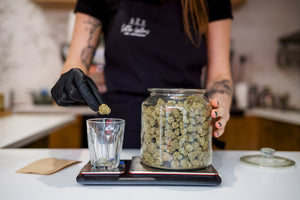
Well-prepared flower should look recognisably intact rather than crushed into powder. Structure varies naturally by cultivar: some flowers are dense and compact; others are lighter or more open. Density alone is not a universal grade.
Look for a reasonably tidy trim, visible resinous structures and colour appropriate to the variety. A few small leaves do not automatically indicate poor quality, but excessive stalk, seed or loose debris may suggest less careful processing. Be cautious if product images are heavily filtered or if every variety uses the same stock photograph.
2. Consider aroma—but do not use it as the only test
Fresh hemp flower may have citrus, fruit, pine, floral, spice or earthy notes arising partly from its terpene profile. The aroma should be credible for the described product. A musty, damp or ammonia-like smell is a warning sign, while a harsh perfume or chemical smell may indicate added fragrance or treatment that has not been disclosed.
Aroma intensity varies by genetics, cure, age and storage. Stronger does not necessarily mean higher CBD or better overall quality. Treat the product description as a guide and the laboratory data as a separate source of evidence.
3. Check moisture and cure
Drying reduces moisture after harvest; curing allows the flower to stabilise under controlled conditions. Flower that is excessively wet can be difficult to store safely. Flower that is extremely dry may crumble easily and lose aroma. A supplier should package and store flower in a way that protects it from both extremes.
Never use flower showing visible fuzzy growth, web-like material, unexplained dark wet patches or a persistent musty smell. Seal it away from other products, retain the packaging and contact the retailer. Do not try to remove a visibly affected section and use the remainder.
4. Understand indoor and glasshouse cultivation
Indoor cultivation gives the grower close control over lighting, temperature, humidity and airflow. Glasshouse cultivation uses natural sunlight while retaining more environmental protection than a fully outdoor crop. Each method can produce excellent flower when managed well, and each can produce poor flower when it is not.
Do not treat “indoor” as an automatic quality certificate. Ask what the cultivation label actually tells you, then judge the finished product using freshness, trim, documentation and storage as well.
5. Read the cannabinoid figures correctly
A product may highlight 18%, 22% or another CBD figure. Check whether that represents CBD alone or “total CBD”, which may incorporate CBDA using a conversion calculation. Make sure the report identifies the sample and uses clear units.
Also review the controlled-cannabinoid panel. A retailer’s generic statement is less useful than a report connected to the batch you are considering. The report should show the laboratory, date, sample identity, method or scope, results, units and reporting limits.
6. Look for traceability
· A named product and cultivar or commercial variety.
· A batch or lot number on the package.
· A test report that matches that product or batch.
· The date of testing and the laboratory’s identity.
· Origin and cultivation method where the supplier can publish them.
· A responsible business name, physical address and contact route.
· Clear storage guidance and net weight.
Testing is not a magic badge. A PDF can be outdated, belong to another product or omit important analytes. Match the identifiers and dates. If they do not correspond, ask the retailer for clarification.
7. Ask whether anything has been added
Some products may be infused, coated or sprayed with cannabinoids, terpenes or other substances. That does not make them equivalent to unmodified flower. Any addition should be clearly disclosed, with supporting safety and legal information. Avoid products marketed with unexplained semi-synthetic or intoxicating cannabinoid names.
8. Assess packaging and storage
Good packaging protects flower from light, air, contamination and uncontrolled moisture while keeping the required label information attached. Once opened, reseal the product promptly. Store it in a cool, dry and dark location and keep it away from children and pets.
Do not move several products into one unlabelled jar. Keeping the original package or batch label means you can identify the product if a question arises later.
9. Be sceptical of medical and effect claims
Testimonials and strain descriptions should not replace evidence. Claims that a flower treats anxiety, chronic pain, insomnia or another condition move beyond ordinary product description and may breach medicines or advertising rules. Quality can be discussed using verifiable characteristics—origin, cultivation, cure, chemistry and freshness—without promising a medical result.
A practical CBD bud quality checklist
· The product photograph appears genuine and specific.
· The flower is intact, appropriately trimmed and free from visible contamination.
· The aroma description is plausible and does not suggest undisclosed additives.
· The CBD figure is defined and linked to a relevant report.
· Controlled-cannabinoid results and reporting units are visible.
· The package includes weight, batch identity and supplier details.
· Storage guidance is provided.
· The retailer answers reasonable questions without making medical promises.
Explore the range
Explore the Little Collins CBD Bud Dispensary and use the product descriptions, percentages, cultivation information and available batch documentation to compare the current range.